Squishy Materials and Fillings: A Buyer’s Guide
A squishy toy is usually a system, not a single material. Its outside shell, internal filling, surface finish, air level, seam, and plug can all influence what you feel and how the product wears.
The safest way to compare materials is to report what the manufacturer or seller actually discloses, then describe observable behavior separately. This guide explains the common constructions without turning sensory nicknames into unverified ingredient claims.
A Squishy Has More Than One Material Layer
When a listing says “TPR squishy” or “foam squishy,” it may describe only the main body or shell. It may not explain paint, coating, internal particles, adhesives, printed decoration, fiber flocking, or the material used to seal an opening.
For a useful product record, separate the construction into four fields: exterior, filling, surface finish, and closure method. Unknown fields should remain unknown rather than being filled with guesses.
The exterior controls first contact
The shell or body controls grip, stretch, initial softness, surface temperature, and much of the durability. A flexible rubber-like shell behaves differently from painted foam or woven plush fabric even when two products are equally soft at first squeeze.
Thickness matters as much as the material name. A thicker wall may feel firmer and protect the filling, while a thin wall may create dramatic bulges but place more stress on seams and plugs.
The filling controls internal movement
Fillings can flow, shift, compress, clump, crunch, or hold shape. The amount of filling and trapped air can change the result, so two units made with the same disclosed ingredients may still feel different.
Visible air is not automatically a defect. In some designs it allows movement, while in others buyers prefer a dense, airless, dough-like squeeze.
The finish controls appearance and wear
Paint, printing, glitter, flocking, powder, and wax-like coatings can create the visual or tactile signature. They can also become the first area to crease, shed, peel, attract lint, or react to cleaning products.
A cracked decorative layer does not always mean the internal body has failed. It still matters to collectors, and sellers should distinguish intended cracking from accidental surface damage.
Common Squishy Shells and Bodies
Polyurethane foam
Polyurethane, often shortened to PU in listings, is widely associated with shaped slow-rise squishies. The foam body compresses and recovers without needing a separate liquid filling, and it can be molded and painted into detailed food, animal, and character designs.
Foam density, shape, size, and skin all affect the rise. “PU foam” alone does not tell you whether a product will be extremely slow, very soft, strongly scented, or resistant to cracking.
The common wear points are folds, narrow details, painted surfaces, and places repeatedly pinched. Foam products should generally be kept dry and cleaned according to their specific instructions rather than soaked.
Thermoplastic rubber and related flexible shells
TPR is a common label on filled squeeze toys because it can form a flexible, stretchable exterior. TPE and other rubber-like terms may appear as well, but shoppers should not assume these abbreviations are interchangeable or that every seller uses them precisely.
A TPR shell can surround gel-like, granular, bead, block, or brand-specific fillings. The shell name therefore does not predict whether the toy will be quiet, crunchy, slushy, moldable, or fast-rebounding.
Seams and plugs are important on filled shells. Stretching the toy far beyond its intended squeeze can concentrate force around those closure points.
Silicone and silicone-like claims
Silicone is used in many flexible consumer products, but the word is also used loosely in marketplace descriptions. Treat a silicone claim as product-specific and look for the named manufacturer, documentation, and care instructions.
Do not identify a shell as silicone solely because it is smooth or stretchy. TPR, TPE, PVC, silicone, and other elastomeric materials can look similar in a short video.
Fabric, plush, and flocked surfaces
Plush toys use fabric as the outer layer and usually rely on fiber or foam stuffing. Fabric-covered squeeze toys may hide a separate stress-ball core, while flocked balls use short fibers attached to a flexible shell.
These distinctions affect cleaning. A spot-clean-only plush item should not be treated like a washable rubber ball, and a flocked surface may lose fibers if scrubbed.
Common Squishy Fillings
Foam as the complete interior
In a classic foam squishy, the foam is both the structure and the compressible interior. Air moves through the foam cells during compression and recovery, but there is no separate bag of liquid inside.
This construction creates the familiar slow-rise reveal. It can also produce wrinkles or temporary dents when the foam is cold, compressed for shipping, or heavily squeezed.
Gel-like, liquid, and fluid fillings
Flowing fillings move away from the fingers and redistribute through the shell. Depending on viscosity and fill level, the sensation may be described as runny, thick, buttery, creamy, slushy, or dough-like.
Those are experiential words, not ingredient verification. If a product page does not state the formula, the accurate description is “fluid-filled” or “gel-like feel,” not a guessed oil, food, or chemical.
PVA and brand-specific formulas
Some brands disclose particular fillings for their own product lines. Schylling says in its official NeeDoh FAQ that most NeeDoh products use a TPR exterior with a PVA filling and that the Nice Cube uses a maltose filling.
That statement is a brand claim about those products, not a recipe for the whole category. “NeeDoh-like,” “maltose feel,” or a similar visual appearance does not prove that another toy uses the same materials.
What happens when nail polish touches a maltose-style gel

Click to load the player (playback stays under your control). Source: “Can Nail Polish Pop This Maltose Squishy?” by Squishdrop on YouTube. Distilled 2026-09-17.
What the video showed: nail polish applied directly to the surface of a maltose-style gel squishy. Within seconds the treated area turned frosted, crackled, and visibly stiffer than the smooth, glossy gel around it. The polish did not puncture the shell or expose the filling in the clip.
What we can and can’t conclude: this is one creator’s demonstration, not a TopToyFun test, and the video doesn’t identify whether the solvent, the pigment, or both caused the reaction. What it does show clearly is that a maltose-style gel surface can react visibly to nail polish. Treat that as a reason to keep this material away from nail polish, polish remover, and other solvents, and to follow the seller’s cleaning instructions rather than testing solvents yourself, not as a controlled chemistry finding.
Beads, blocks, foam pieces, and inclusions
Solid inclusions create movement, pressure points, and sound. Fine foam beads can feel soft and airy, larger blocks can create a structured crunch, and rigid particles can produce sharper tactile feedback.
A clear shell may make these components visible, but an opaque toy may only reveal them through sound and touch. If the component is not disclosed, avoid naming it from audio alone.
Powder, flour-like, sand-like, and dough-like fills
Powdery or granular fillings can create a dense product that holds fingerprints or a flattened shape. Buyers often search “flour stress ball” or “sand-filled squishy,” yet commercial formulas may differ from homemade versions.
A flour-like feel does not confirm actual flour, and a sand-like sound does not confirm mineral sand. Product-specific disclosure matters because cleaning, allergies, leakage, and disposal may depend on the real filling.
Vaseline and petroleum-jelly feel
Some listings and reviewers describe a doughy or slushy filling as feeling like Vaseline or petroleum jelly. This guide treats that as a sensory comparison, not a formula claim: petroleum jelly or a related petroleum-based ingredient is named as an actual filling only when a seller or manufacturer discloses it for that specific product.
Where no such disclosure exists, the accurate description is a “petroleum-jelly feel” or “Vaseline-like texture,” a comparison to a familiar household product rather than a statement about what is inside. Treat a product described this way like any other undisclosed filling: ask the seller before assuming a composition, and follow that product’s own care and safety instructions rather than instructions written for actual petroleum jelly.
Water beads and expanding components
Some squeeze toys contain water beads or other expanding materials. These require special caution because loose beads can pose a severe ingestion hazard, particularly around young children.
The CPSC Water Beads Information Center explains the hazard and current U.S. safety actions. Stop using any toy that opens or releases its contents, and follow current recalls and warnings.
Polyester fiber and plush stuffing
Plush squishies commonly use polyester fiberfill or another disclosed stuffing. The experience is quieter, warmer, and less fluid than a sealed stress ball, and the object may be used as a pillow or display piece.
Stuffing distribution can shift over time. Stitching, fabric strength, and care labels become more important than a rubber plug or liquid seal.
How Construction Changes Feel, Sound, and Rebound
Material names are only the start of the sensory description. The same outer material can feel different when wall thickness, fill level, shape, temperature, or particle size changes.
| Construction clue | Likely sensory effect | What still needs verification |
|---|---|---|
| Painted slow-rise foam | Gradual visual recovery, quiet squeeze | Foam density, rise time, paint durability, odor |
| Flexible shell with thick fluid | Flowing or doughy movement | Actual filling, seam design, air level, leakage history |
| Shell with beads or blocks | Crunch, shift, textured resistance | Particle material, shell thickness, closure strength |
| Fabric with fiberfill | Soft, quiet, compressible | Wash method, stitching, fill recovery |
| Breakable surface coating | First-squeeze crack or crisp sound | Coating composition, shedding, repeatability, cleanup |
Resistance is not the same as rebound
Resistance is the force you feel during compression. Rebound is what happens after release, so a dense moldable filling can resist the hand yet barely rebound.
This distinction is essential when translating review language. “Too hard” may refer to resistance, while “doesn’t rise” refers to recovery behavior.
Sound comes from interactions
Crunch and slush are usually interactions between the shell, filling, air, and the way the toy is squeezed. A microphone can exaggerate delicate sounds, so compare unedited demonstrations and read descriptions of normal-room use.
For quiet environments, prioritize explicit quiet-use evidence rather than assuming a smooth shell will be silent. Air pockets, sticky surfaces, and internal particles can all add sound.
A Clear Construction Example
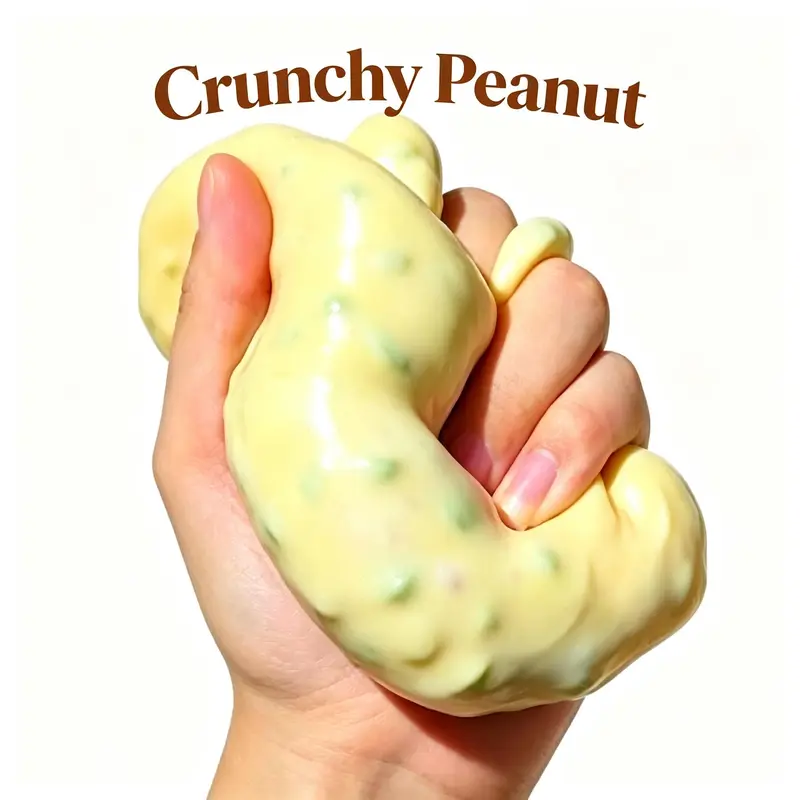
See the Crunchy Peanut Squishy Toy
Its current product page identifies a firm TPR exterior and internal balls and blocks, which is more useful than the word “crunchy” alone. Use that level of disclosure when comparing any material-based listing.
How to Read Material Claims
Separate fact, claim, observation, and inference
A test report or legally required label is different from a seller description. A manufacturer statement is still useful, but it should be attributed; a buyer comment is a subjective experience; a visual guess is an inference.
Good editorial wording makes the level clear: “the brand states,” “the listing identifies,” “a reviewer reported,” or “the movement appears consistent with.” It does not silently turn any of those into independently verified composition.
Watch for unsupported reassurance
Words such as “non-toxic,” “food-grade,” “safe for all ages,” and “therapeutic” should not be accepted without relevant evidence and appropriate context. The fact that a product is sold online or resembles a familiar brand is not proof of compliance.
Strong chemical odor, oily residue, missing age grading, absent manufacturer information, and unknown contents are reasons to pause. The CPSC’s 2026 consumer safety alert highlights these signs and warns against heating squishy toys.
A Material-First Buying Checklist
- Identify the exterior, filling, coating, and closure separately.
- Check whether material language comes from the brand, retailer, seller, reviewer, or editor.
- Compare resistance, rebound, sound, and shape-holding instead of relying on “soft.”
- Look for dimensions and fill level because scale changes hand feel.
- Read complaints about seam splitting, plug failure, leaks, residue, odor, paint, and shedding.
- Verify age grading, manufacturer or importer details, warnings, and care instructions.
- Do not use a cumulative sold badge or one viral video as proof of quality.
If a listing omits the information most relevant to your use, ask before buying or choose a product with clearer disclosure. “Unknown” is a legitimate data field and better than a confident guess.
Frequently Asked Questions
Q: Are all slow-rise squishies made from PU foam?
No. PU foam is common in shaped slow-rise toys, but a slow return can also result from a filled shell or another construction.
Q: Does a maltose feel mean the toy contains maltose?
No. “Maltose feel” is often used as a sensory comparison, while only a product-specific disclosure can establish the actual filling.
Q: Is TPR the filling or the shell?
It is often used for the flexible exterior of a filled squeeze toy, but listings vary. Read the full construction description to learn what, if anything, is inside.
Q: Are homemade flour stress balls the same as commercial doughy squishies?
Not necessarily. Commercial products may use different shells, fillers, preservatives, seals, and testing, even when the hand feel seems similar.
Q: Can I identify the filling from a video?
You can describe visible movement, sound, rebound, and shape holding, but you usually cannot prove the chemical or ingredient composition from a video alone.
Q: Which filling lasts the longest?
There is no universal winner because durability depends on the whole construction, use pattern, storage, seams, coatings, and quality control. Product-specific testing and long-term owner reports are more useful than a filling name by itself.
Informational notice: This guide explains common product constructions and public claims; it is not a chemical analysis, safety certification, or substitute for current manufacturer instructions and recall information. Stop using damaged, leaking, or opened products and keep released fillings away from children and pets.