Squishy Texture, Sound and Rebound Explained
The best description of a squishy is not simply “soft.” A useful description tells you how it resists the hand, whether the filling flows or holds shape, what sound appears during a squeeze, and how the toy returns after release.
This guide turns community words such as doughy, buttery, slushy, crunchy, crispy, slow rise, and no rebound into a practical comparison system. It also shows where those words overlap, where they conflict, and what an online demonstration can and cannot prove.
How this guide was built: The texture, sound, and rebound families below are compiled from publicly available product listings, brand descriptions, and video demonstrations across many squishy toys, not from a single controlled TopToyFun lab test with a fixed sample size. Where a specific claim has a traceable source, we link to it directly; where no such source exists, we say so instead of presenting a guess as a finding.
Texture, Sound, and Rebound Are Different Dimensions
Texture is what you feel during contact and movement. Sound is what the shell, air, coating, and filling produce together, while rebound is the recovery after your hand releases pressure.
A toy can be doughy and quiet with almost no rebound. Another can be soft, slushy, and fast returning, while a third can be firm, crunchy, and slow to reshape.
Resistance: how hard does it push back?
Low-resistance toys collapse with little pressure. Medium-resistance toys provide a noticeable squeeze without fighting the hand, and firm-resistant toys require a stronger grip or a slower kneading motion.
Resistance is personal. A child, an adult with a strong grip, and someone with limited hand mobility may describe the same product differently, so dimensions and demonstration matter alongside adjectives.
Movement: what happens inside the squeeze?
Some products compress evenly, some flow away from the fingers, and some shift in chunks or particles. Moldable fillings can stay where the hand moves them, while fluid fillings keep redistributing through the shell.
The movement pattern often matters more than the nominal material. Buyers seeking a “no air, mochi-like” hand feel are usually describing dense continuous movement, not requesting a specific chemical formula.
Recovery: what happens after release?
Fast-rebound toys snap back, slow-rise toys visibly rebuild, and moldable toys may retain a dent or folded shape. Some products show mixed behavior, with the shell returning quickly while the filling redistributes more slowly.
Rise time can change with temperature, repeated use, and the depth of the squeeze. A single edited clip should be treated as a demonstration, not a controlled specification.
Common Squishy Texture Families
Soft-collapse and marshmallow-like
A soft-collapse squishy folds or compresses easily and can feel airy, pillowy, or marshmallow-like. Slow-rise foam often appears in this family, but a soft shell with a light filling can create a similar first impression.
Choose this feel for gentle full-palm squeezing and visual recovery. Check whether the product is delicate, because very soft painted details and thin extensions may crease or tear sooner than a simple rounded form.
Doughy, putty-like, and kneadable
Doughy squishies feel dense and continuous, inviting folding, thumb pressing, and kneading. Reviewers may use “mochi,” “maltose,” “flour-like,” “buttery,” “creamy,” “coconut-oil feel,” or “petroleum-jelly feel” as sensory comparisons.
Those phrases do not verify ingredients. Use them to understand movement and resistance, then look for the seller’s actual shell and filling disclosure.
Moldable and shape-holding
Moldable toys retain a flattened area, finger impression, or folded form instead of immediately smoothing out. They are often described as “no rebound,” “reboundless,” “holds shape,” or “slow melt.”
This can be satisfying for deliberate hand work and transformation videos. It also puts repeated bending pressure on the shell, so seam and plug construction deserve attention.
Fluid and flowing
Fluid-filled toys push the contents around the hand and may create smooth bulges or a rolling sensation. Opaque products can feel dense and airless even when the filling cannot be seen, while clear versions make the movement part of the visual appeal.
Words such as “fluid ball” or “liquid squishy” describe behavior at a broad level. They do not reveal whether the filling is water-based, gel-like, PVA-based, oil-based, or something else.
Slushy, sandy, and snow-like
Slushy texture combines flow with fine internal grain. The hand may feel a subtle granular movement, and the microphone may pick up a wet, icy, sandy, or snow-like sound.
Particle size and liquid level change the result. “Sandy” can describe sound without proving that actual sand is inside.
Crunchy, bead-filled, and block-filled
Crunchy products contain moving structures that press, shift, or rub during a squeeze. Fine beads can feel bubbly, large blocks can feel geometric, and mixed inclusions can create irregular resistance.
Some buyers want a strong audible crunch; others want tactile movement without much noise. Product videos should ideally show normal-room audio as well as close-microphone ASMR.
Fuzzy, flocked, and plush
Fuzzy surfaces change the first contact before compression begins. They feel warm and soft, reduce slippery handling, and often produce less obvious internal sound.
Flocking may be attached to a flexible core, while plush fabric may surround stuffing. Lint pickup, fiber shedding, stitching, and cleaning method matter more than they do for a smooth shell.
Sticky, tacky, and powder-finished
A slight tack may be intentional in some rubber-like products, and powder may be used to reduce it. New or worsening oily residue, extreme stickiness, or stickiness combined with a strong chemical odor should not be dismissed as a texture preference.
Follow the product’s care instructions rather than applying random powders or cleaners. A method recommended by one brand may not be appropriate for a different shell or coating.
Common Squishy Sound Families
Quiet and low-sound
Quiet squishies are useful in offices, classrooms, travel, or shared spaces. Slow-rise foam and plush often produce limited sound, although surface tack, escaping air, or packaging can still be audible.
“Quiet” should describe ordinary use, not a video with muted audio. If discretion matters, look for owner comments recorded outside an ASMR setup.
Slush, squelch, and wet sound
Fluid movement can produce slush, squelch, or soft bubble sounds. A granular component may add a fine scrape or snow-crush layer.
Close microphones amplify detail and can make a subtle product sound dramatic. Compare the creator’s hand movement and recording distance before expecting the same volume.
Crunch, crackle, and pop
Crunch can come from internal particles, a bead network, a block filling, trapped air, or a designed coating. Pop may describe a sharper isolated event, while crackle usually suggests many small sounds.
These are not standardized terms. Sellers should pair the word with a construction description or a representative unedited demonstration.
Crispy crack and first-squeeze coating sounds
Wax-coated or crispy styles often produce their strongest sound when an intact surface layer first breaks. Later squeezes may be softer because the coating has already fractured.
That makes “first squeeze” and “repeat squeeze” different experiences. A good review shows both and mentions whether fragments shed or remain attached.
Air hiss and shell squeak
An air hiss may come from foam recovery, a valve-like opening, or movement around a seam. A squeak may come from fingers moving against the exterior rather than from the filling.
These sounds can change with hand moisture and speed. Listen for multiple full cycles instead of judging from a single emphasized squeeze.
Rebound Styles From Snap-Back to No Rebound
Fast rebound
Fast-rebound toys restore their shape almost immediately. They work well for repeated rhythmic squeezing and short visual loops because the start and end frames naturally match.
Fast does not necessarily mean hard. A soft shell can rebound quickly when the filling and internal pressure support rapid return.
Medium rebound
Medium rebound offers a visible recovery without the long wait of a classic slow-rise foam toy. It can balance continuous play with a satisfying release moment.
Because “medium” is subjective, a listing should show a timed full squeeze when possible. Compare products of similar size and compression depth.
Slow rise
Slow-rise squishies return over several seconds or longer, creating an obvious transformation. The effect is especially visible in foam food shapes, cubes, buns, and other forms with a clear original silhouette.
Rise speed is not a permanent promise. Cold temperatures, storage compression, age, and surface damage can affect the recovery.
No rebound and deliberate reshaping
No-rebound or reboundless products stay dented or folded until the user works them back into shape. The appeal is the controlled, almost sculptural movement rather than a spring response.
The category boundary is fuzzy because some “no rebound” toys slowly relax on their own. Look for a longer demonstration instead of relying on the label.
Mixed or staged rebound
A filled shell can snap back externally while the contents continue flowing inside. A layered product may recover in stages, creating a quick outline change followed by a slower smoothing process.
This mixed behavior is often why two viewers describe the same toy differently. One focuses on the shell, while the other focuses on the internal fill.
How to Compare Squishy Videos and Listings
Use a consistent observation sequence. Watch the untouched shape, the first contact, a full squeeze, a held squeeze, the release, the complete recovery, and a second squeeze.
- Is the video speed normal and continuous?
- Can you see the whole hand and full product?
- Is the audio natural, amplified, replaced, or unclear?
- Does the toy hold fingerprints, a fold, or a flat side?
- Does the shell stretch evenly or concentrate at a seam?
- Are dimensions, material claims, and random variants disclosed?
- Do independent buyers use similar sensory words?
Social proof can identify language and content patterns, but it does not reveal private conversion, return rates, or long-term durability. A viral clip is an observation point, not a market-size estimate.
A Slushy Texture Example
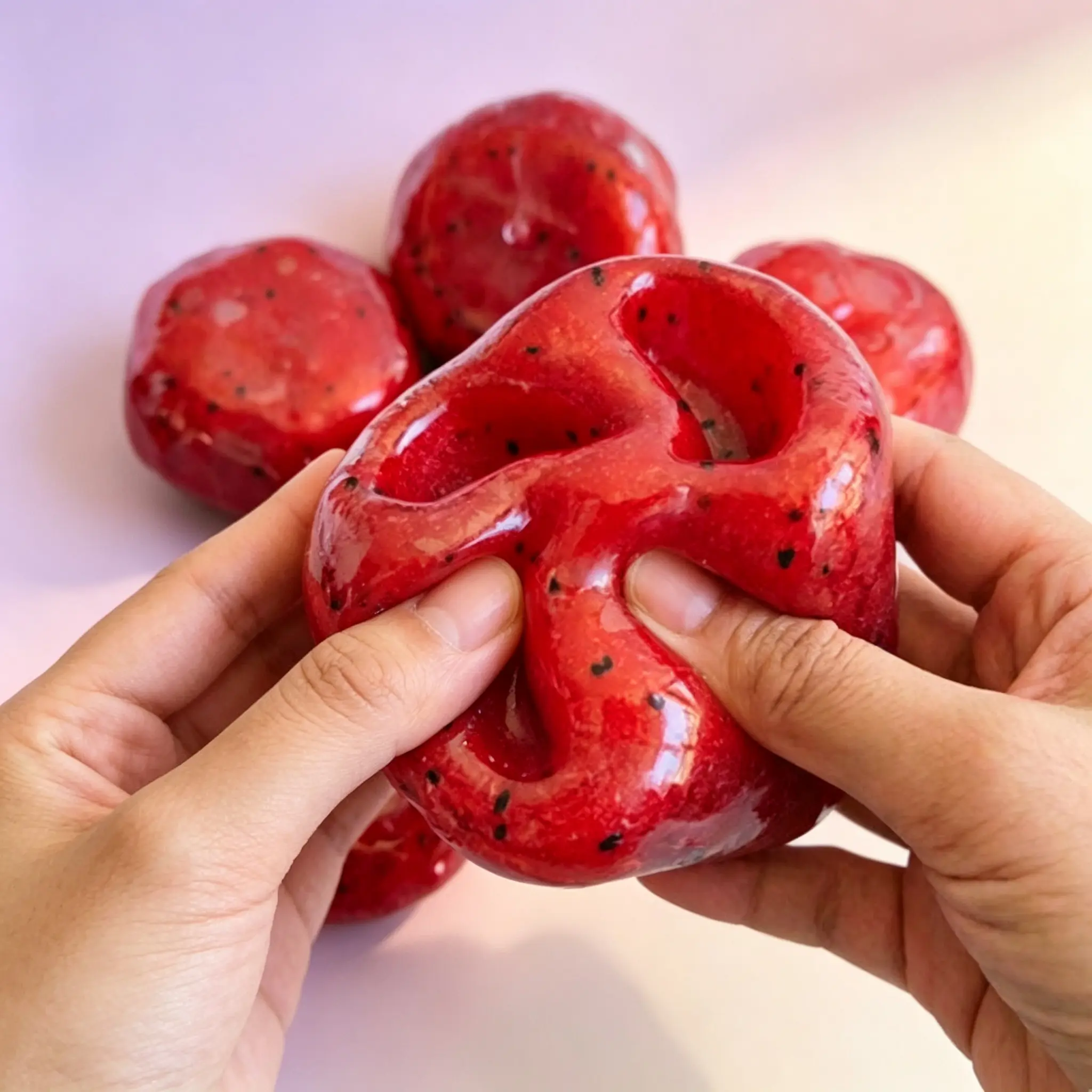
See the Watermelon Red Slushy ASMR Squishy Ball
The current page describes a slush-filled ball with fluid, gritty movement. It is a useful reminder that texture, sound, and rebound should be evaluated separately, even when one ASMR word leads the listing.
Match the Sensory Profile to the Situation
For repetitive squeezing
Prioritize comfortable resistance and fast or medium rebound. A shape that fits the palm and a surface that stays manageable during longer use may matter more than decorative detail.
For slow visual satisfaction
Choose a slow-rise product with a clear recovery demonstration. Large smooth shapes often display the effect more clearly than thin limbs or complex edges.
For kneading and shape holding
Look for doughy, moldable, holds-shape, slow-melt, or no-rebound evidence. Check seams carefully and avoid pulling the shell beyond the intended motion.
For sound-focused ASMR
Choose a sound family first, then decide whether you want repeatable slush or crunch versus a stronger first-squeeze crispy crack. Confirm how the toy sounds without heavy amplification.
For quiet shared environments
Favor quiet foam, soft plush, or a specifically demonstrated low-sound item. Avoid assuming that a product is quiet merely because it lacks visible beads.
When a Sensory Trait Becomes a Warning Sign
A new strong chemical smell, oily film, unexpected stickiness, leaking filling, loose coating, or visible opening is not merely a new texture. Stop using the product, keep contents away from children and pets, and follow seller, manufacturer, and current safety guidance.
Never microwave or heat a squishy to change its texture or rebound. The CPSC warns of serious burn hazards and advises consumers to inspect packaging, manufacturer information, warnings, and age grading.
Frequently Asked Questions
Q: What is the softest type of squishy?
There is no universal softest type because size, density, shell thickness, fill level, and personal grip all matter. Soft-collapse foam and lightly resistant filled toys are common starting points.
Q: What does doughy mean for a squishy?
Doughy usually describes dense, continuous movement that can be pressed and kneaded. It is a sensory description, not proof that dough, flour, maltose, or another specific ingredient is inside.
Q: Is slow rise the same as no rebound?
No. Slow rise means the toy eventually recovers on its own, while no-rebound or moldable products may hold their new shape until manually reshaped.
Q: Why does a squishy sound louder online?
Close microphones, quiet rooms, audio processing, and editing can amplify subtle internal movement. Look for normal-distance demonstrations and several complete squeeze cycles.
Q: What is a crispy squishy?
It commonly refers to a toy with a surface or internal effect that creates a sharp crack or crisp sound. Some coatings are designed for a dramatic first squeeze and may not sound the same afterward.
Q: Can texture tell me what filling is inside?
Texture can suggest a broad movement family, but it rarely proves the formula. Use the seller’s current disclosure and treat unsupported ingredient guesses as unknown.
Informational notice: Sensory terms are subjective and product construction can change. This guide does not replace manufacturer instructions, age grading, safety testing, recall information, or individualized medical advice.